
A star topology is a configuration used in Local Area Networks (LANs) where each node is individually linked to a central connection point, such as a hub or a switch. In contrast to a bus topology, a star network requires more cabling, but it offers the advantage that if a cable fails, only one node is affected.
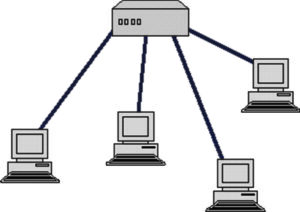
In a star topology, all data traffic originates from the central hub of the network. This central hub typically consists of a high-performance, self-contained computer that manages the routing of all communication between nodes. The primary benefit of a star network is its ability to isolate the impact of a malfunctioning node, ensuring that the rest of the network remains unaffected. However, this topology can be susceptible to potential bottlenecks and failures at the central hub.
It’s worth noting that a star network is sometimes combined with a bus topology, where the central hub connects to the backbone of the bus. This hybrid configuration is referred to as a tree topology