
Multiple Input Multiple Output (MIMO) is a wireless communication technique that leverages multiple antennas at both the transmitting and receiving ends of a communication link, such as between a base station and a terminal device in a wireless network. MIMO technology is designed to enhance the performance and reliability of wireless communication systems by exploiting spatial diversity and multipath propagation characteristics.
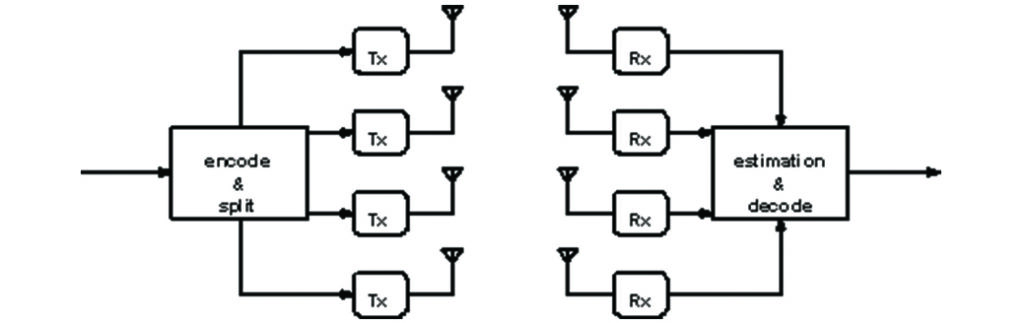
Key features of MIMO technology include:
- Multiple Antennas: MIMO systems use multiple antennas at both the transmitter and receiver. These antennas work in coordination to transmit and receive data simultaneously, effectively increasing the system’s capacity and reliability.
- Spatial Diversity: MIMO takes advantage of the fact that signals transmitted from a single source may take multiple paths to reach the receiver due to reflections and scattering in the environment. By using multiple antennas, MIMO can capture these diverse signal paths, reducing the impact of fading and improving signal quality.
- Multipath Fading Mitigation: In wireless communication, signals can suffer from multipath fading, where different versions of the transmitted signal arrive at the receiver with different phases and amplitudes. MIMO helps combat this fading by combining signals from multiple antennas to improve the overall signal-to-noise ratio.
- Increased Data Rates: MIMO technology enhances the data rate of a wireless link by transmitting multiple data streams simultaneously on the same frequency channel. This is achieved by spatially separating the signals using multiple antennas.
- Spatial Multiplexing: MIMO systems can use spatial multiplexing to send multiple independent data streams over the same frequency channel. This technique allows for higher data rates without requiring additional bandwidth.
- Improved Coverage and Range: MIMO can improve coverage and extend the range of wireless networks by increasing signal strength and reducing interference.
MIMO technology is widely used in various wireless communication standards, including Wi-Fi (802.11n, 802.11ac, 802.11ax), 4G LTE, 5G, and wireless LANs. It plays a crucial role in improving the performance and capacity of wireless networks, making it suitable for both mobile and fixed wireless communication systems.