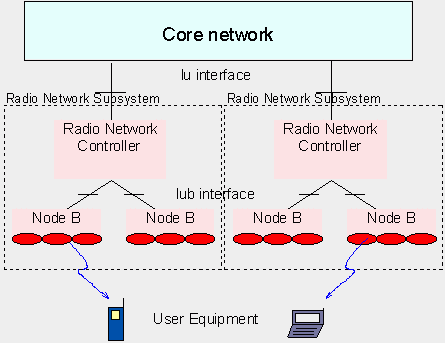
The UMTS Terrestrial Radio Access Network (UTRAN) is a crucial part of the UMTS (Universal Mobile Telecommunications System) architecture, responsible for providing wireless communication services to mobile users. UTRAN serves as the fixed network infrastructure that enables the transmission of data to and from mobile devices via radio waves. Here’s an explanation of the key components and their roles within UTRAN:
- Base Stations (Node B):
- The base stations in UMTS, known as “Node B,” are physical radio transceiver units strategically located throughout a geographical area, typically covering a specific cell or cell sector. These Node Bs are responsible for transmitting and receiving radio signals to and from mobile devices within their coverage area.
- Node Bs are equipped with antennas and radio equipment that communicate directly with mobile devices, such as smartphones and tablets. They manage the radio communication, including signal transmission, reception, and modulation/demodulation.
- Radio Network Controllers (RNC):
- The Radio Network Controllers (RNCs) are control nodes in the UTRAN architecture that play a vital role in managing and controlling the operations of multiple Node Bs within a given region or coverage area.
- RNCs serve as the intelligence behind UTRAN, responsible for tasks like handover management, resource allocation, quality of service (QoS) enforcement, and overall network optimization.
- They are responsible for establishing and maintaining connections with mobile devices, ensuring smooth and efficient communication, and handling various radio-related functions.
- RNCs also manage mobility across different cells and sectors within the UMTS network, ensuring that mobile users can seamlessly move between coverage areas without losing their connection.
- Core Network (CN):
- The Core Network (CN) is a central part of the overall UMTS network architecture, connecting various access networks (like UTRAN) to the broader telecommunications infrastructure.
- The CN provides core services such as call routing, data routing, authentication, and billing. It interfaces with various network elements to enable end-to-end communication and service delivery.
- Radio Network Controllers (RNCs) within the UTRAN are connected to the Core Network, ensuring that data from mobile devices can be routed to their intended destinations, such as other mobile devices, fixed-line phones, or internet servers.
- The CN also interfaces with other networks, including the public switched telephone network (PSTN) and the internet, to enable voice and data communication between mobile users and external services.
In summary, UTRAN, consisting of Node Bs and Radio Network Controllers (RNCs), forms the radio access network of the UMTS system. Node Bs manage the radio communication with mobile devices, while RNCs provide control and coordination for multiple Node Bs in a given area. The Core Network (CN) connects UTRAN to other parts of the telecommunications network, facilitating end-to-end communication and enabling mobile users to access a wide range of services.