
Sampling is the procedure of converting a continuous-time signal into a discrete-time signal by capturing the signal at regular time intervals.
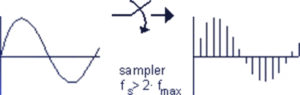
As the number of samples per second increases, the sampled signal becomes a closer approximation of the original continuous signal. When the sampling rate is sufficiently high, it contains all the necessary information to fully reconstruct the original signal. The Nyquist sampling theorem establishes that a signal can be perfectly reconstructed if it is sampled at a rate greater than or equal to twice the frequency of its highest-frequency component.
Sampling represents the initial stage in the digitalization of an analog signal. Following the sampling process, the samples must undergo quantization