
Orthogonal Frequency Division Multiplexing (OFDM) is a transmission technology widely used in modern communication systems to efficiently send and receive data over wireless and wired channels. OFDM divides the available bandwidth into multiple orthogonal subcarriers, each carrying a portion of the data. This technique offers several advantages, making it suitable for various applications, including digital TV, digital radio, mobile communication (such as 4G LTE and 5G), and broadband internet access (like ADSL and VDSL). Here are key features and applications of OFDM:
- Robust Against Fading: OFDM is highly resistant to frequency-selective interference and fading, such as multipath fading. When a portion of the signal is affected by interference or fading, only the data on the corresponding subcarrier is impacted, reducing the impact on the overall transmission.
- High Spectral Efficiency: OFDM allows for the efficient utilization of available bandwidth. The subcarriers can be placed close to each other, optimizing spectral efficiency and allowing more data to be transmitted within the same frequency range.
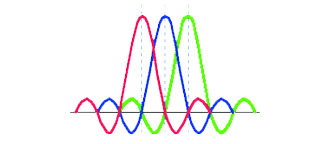
- Orthogonal Subcarriers: The subcarriers used in OFDM are orthogonal to each other, meaning they do not interfere with one another. This orthogonality ensures that the subcarriers can be closely spaced without causing interference.
- Resilience to Interference: OFDM’s robustness against interference and noise makes it suitable for environments with challenging conditions, such as urban areas with reflections and multipath propagation.
- Broad Range of Applications: OFDM is used in a wide range of communication systems, including wireless technologies like Wi-Fi, cellular networks (e.g., 4G LTE, 5G), and digital broadcasting (e.g., DVB-T for digital TV, DAB for digital radio). It is also utilized in wired technologies like DSL (e.g., ADSL and VDSL) for broadband internet access.
- OFDM with Coding (COFDM): To further enhance error correction capabilities, OFDM is often combined with forward error correction coding, resulting in COFDM. This combination improves data reliability and error recovery in challenging channel conditions.
- Discrete MultiTone (DMT): In the context of digital subscriber line (DSL) technologies like ADSL and VDSL, the same underlying principle as OFDM is referred to as Discrete MultiTone (DMT). DMT divides the frequency spectrum into subcarriers for efficient data transmission over copper phone lines.
Overall, OFDM’s ability to efficiently use available spectrum, resist interference, and adapt to various communication scenarios has made it a fundamental technology in modern telecommunications, enabling high-speed data transmission in both wireless and wired networks.