
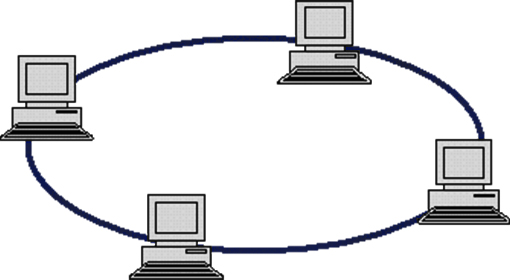
Ring topology, commonly used in Local Area Networks (LANs), is a network configuration where each device is connected to exactly two other devices, forming a single continuous pathway for signals through each device – a ring. Data travels in one direction around the ring, with each device having the capability to receive from the left and transmit to the right.
Advantages of Ring Topology:
- Efficient Data Handling: Ensures that data can be transmitted with minimal chances of packet collisions because each packet gets sent around the ring until it reaches its destination.
- Equal Access: Every device has equal access to resources and opportunities to transmit.
- Simple to Install and Reconfigure: Adding or removing devices is relatively easy and doesn’t affect the network significantly.
- Failure Detection is Easy: It’s easier to identify the problem if a segment of the network goes down.
Disadvantages of Ring Topology:
- Single Point of Failure: A break in the ring (such as a failed device) can disrupt the entire network. This can be mitigated by implementing a dual ring or a switch that closes the loop if a break occurs.
- Slower Speeds Compared to Other Topologies: Because data must pass through many nodes, the speed can be slower than in a star or mesh topology.
- Complexity in Troubleshooting: Determining where the failure occurred can be more complex compared to other topologies.
Use in WANs and MANs:
In Wide Area Networks (WANs) and Metropolitan Area Networks (MANs), ring topology is often used for the backbone network. Here, the ring might be used in both directions to provide redundant paths. This setup, sometimes referred to as a “city ring,” enhances the network’s resilience and reliability by offering alternate routing paths for data in case of a failure in one segment of the network. This bidirectional use of the ring topology in larger networks is crucial for maintaining robust and uninterrupted network service across a broad area.