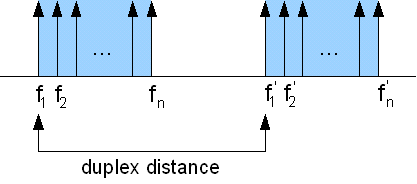
Radio spectrum is frequently structured and traded as paired spectrum. This involves a segment of spectrum in a lower frequency range and a corresponding segment in a higher frequency range. The concept of paired spectrum entails using one band for sending signals (uplink) and another for receiving them (downlink).
Within these paired frequency blocks, numerous channels are matched with corresponding channels in the other block. One channel is dedicated to transmission in one direction (such as from a base station to a subscriber terminal), while another channel operates in the reverse direction (from the subscriber terminal back to the base station). These frequency pairs are spaced apart by a “duplex distance” to ensure that the signals remain isolated and do not interfere with each other. If the frequencies are too close, there’s a risk of the transmitting signal overpowering the receiving signal.
Paired spectrum is often described in terms like “2×15 MHz,” indicating 15 MHz in a lower band and an equivalent 15 MHz in a higher band. This method, where two users communicate over two distinct frequencies, is known as Frequency Division Duplex (FDD).